

INTERVIEW: FOR AC The University of Tokyo Hospital: A new option for appearance care, "beauty therapy"
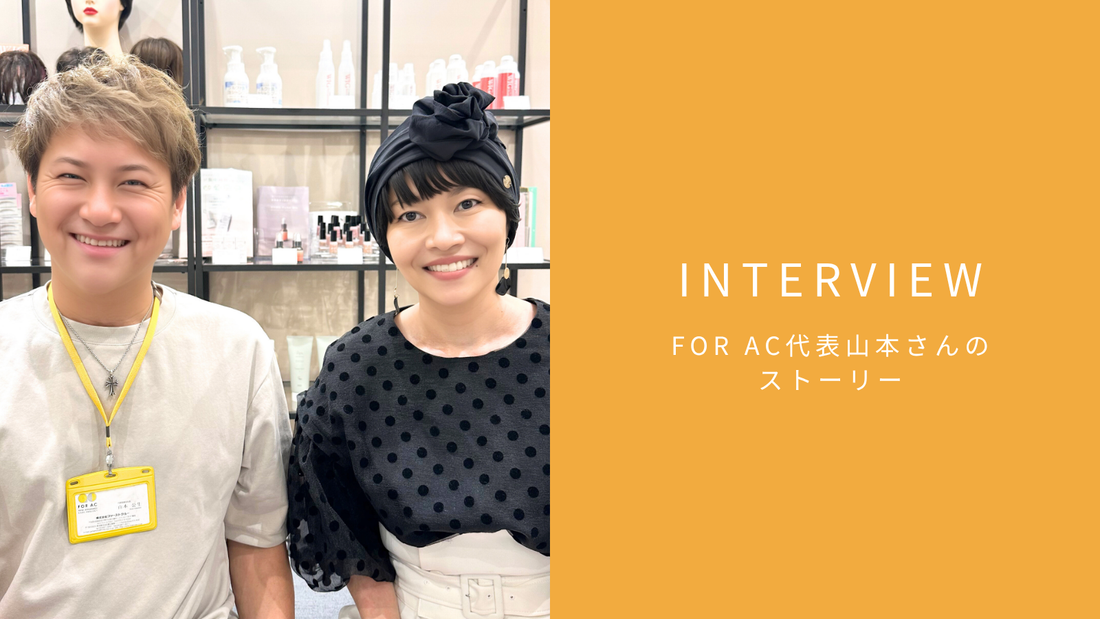
Hello, this is Mayumi from BAREN.
BAREN products are now available to try on and purchase at FOR AC inside the University of Tokyo Hospital , and it seems that many people have already come to try on BAREN products.
We believe that providing a space where customers can try on items before purchasing is a big step for BAREN.
So this time, we interviewed Yamamoto Kimio, the representative of FOR AC, which provides appearance care for cancer patients.
I would love to hear more about FOR AC and appearance care!
Q. Hello, Mr. Yamamoto! I would like to ask you briefly about your background.
Hello.
I am a hairdresser and currently run six beauty salons called HANABUSA in Kanazawa. I also volunteer for vocational training overseas and am involved in a variety of activities both in Japan and overseas. 
In connection with this, we also operate a store called "HANABUSA CO+MEDICAL" that specializes in hair growth and thinning hair care. As we cater to each customer's concerns in private rooms, we have received several enquiries about hair loss caused by chemotherapy and medical wigs.
At the time, it was outside my area of expertise and I didn't have the knowledge, so I ended up turning down the offer, but looking back, I think that was the first time I became aware of hair loss caused by chemotherapy and medical wigs.
Q. So you declined at the time. Can't regular beauty salons handle hair removal or medical wigs?
I think the reality is that most hairdressers are reluctant to do this. They don't have any knowledge about hair loss caused by chemotherapy, and medical wigs are expensive, so if they make a mistake with the cut, they may have to pay for it. I think that because of these risks, most stylists refuse.
We were forced to decline at the time, but we always felt that there was no place for people who were struggling with hair loss or dealing with medical wigs to go.
Q. Did meeting patients like that make you interested in appearance care?
In fact, I first learned more about appearance care after meeting Dr. Takako Bunta, a doctor in the Department of Breast Surgery at the University of Tokyo Hospital and a leading researcher in "appearance care." Dr. Bunta recognized the importance of appearance care in cancer treatment and is working to spread the word about appearance care. She taught me a lot about cover-up makeup, medical wigs, protective hats, nail care, and more.
As my knowledge grew, I began to feel more and more that even though hairdressers like myself are supposed to be hair professionals, we weren't doing anything in this field.
Q. At that time, Appearance Care connected you with customers you had previously turned away.
That's right. I felt it was our responsibility as beauticians that there were no people or places to monitor and support changes in appearance, so I began to think about how we could combine beauty and medicine.
The professionals who provide treatment are doctors, and the professionals who make medical wigs are medical wig manufacturers, but I believe that the professionals who suggest hairstyles and designs for medical wigs should be hairdressers. I thought that this was a mission that someone had to fulfill, so I started working in the field of appearance care.
Q. Is there anything you keep in mind since you started working on appearance care?
I think the most important thing in appearance care is to make patients feel at ease.
Patients are anxious before the start of anti-cancer drug treatment-induced hair loss. Even if the doctor says, "Your hair loss will begin soon, so please prepare," they don't know when and what changes will occur, or what they should actually do to prepare.
At times like these, I think it would be very reassuring to have a professional who can give advice like, "Have you been told you need a wig? Hair loss will begin at this point once you start chemotherapy, so take your time to choose one," or, "It will definitely grow back, so don't worry," or, "Hair loss as a side effect is proof that the chemotherapy is working."
And only when you have that sense of security can you improve your quality of life and feel motivated to enjoy fashion.
Appearance care is not just about buying a medical wig and then being done with it, so I hope you will feel free to come and have your hair adjusted when you need it during hair loss or hair growth, or just when you want to change your mood, just like you would at a beauty salon. I would be happy if you could feel reassured and think, "I'll be fine if I come here!"

Q: Is there anything you keep in mind when interacting with customers?
I am always aware of how I should position myself for my customers.
I believe that what FOR AC's customers need is not someone who will grieve with them, but someone who can teach them solutions. To be that kind of person, we need to face our customers with not only our technical skills but also all the knowledge we can muster. The important thing is not whether we are able to solve the problem in the end, but rather we strive to be there for them, trying to lead them to a solution to their anxieties and problems.
Q. I would like to ask about FOR AC's future prospects.
The first is the expansion of FOR AC franchises.
We define the appearance care provided by FOR AC as "medical care" + "beauty" = "beauty therapy," and by eventually increasing the number of stores to 200, we hope to make this "beauty therapy" available to patients all over the country.
We provide courses on appearance care that not only teach techniques such as how to care for medical wigs, but also lecture on illnesses and other topics, and issue diplomas to hairdressers who take the course. Currently, we have 10 salon franchises, and we aim to increase our name recognition so that people will understand that we are an "appearance care salon" just by seeing the name "FOR AC."
The second goal is to increase the number of FOR AC stores within hospitals, like this one at the University of Tokyo Hospital. If it's located within a hospital, patients can drop in on their way to a consultation, which is the friendliest and most accessible option for them. Starting with the University of Tokyo Hospital, I hope to set up FOR AC stores in many hospitals, making appearance care more accessible to patients.
Q.Please tell us why you decided to carry BAREN.
When I saw the pamphlet, I thought, "This is it!" and contacted them right away.
Not only are BAREN's designs and comfort excellent, but FOR AC and BAREN share a similar philosophy, so we thought it would be easy to introduce to our customers.
FOR AC provides appearance care tailored to each patient's concerns in order to meet their desires of "I want to enjoy fashion even during treatment" and "I want to continue living as myself forever." Changes in appearance can have a big impact on the mind, so we believe that by dressing up, you can regain the happiness of being able to laugh naturally with others.
I heard that BAREN was born from Mayumi's desire for more comfortable and stylish wigs and hats while undergoing treatment for cervical cancer. That's why she has thought carefully about what kind of products will make people smile even during treatment.
I thought that with BAREN, patients would want to dress more fashionably during treatment than they did before hair removal.

Q. Thank you! Is there anything you would like to do with BAREN in the future?
I'd love to conquer the whole country with BAREN! By franchising and increasing the number of stores nationwide, I want to create an environment where people can receive appearance care no matter where they are.
We have already received a lot of positive feedback, so we expect that the number of customers who want to try on BAREN products will continue to increase in the future, and we hope that we can continue to attract customers and grow together.

I hope we can work together on various things! Thank you very much!


